
explore the world through the universal language of food

Cao Lầu - A Hoi An Specialty
Cau Lau is a signature noodle dish from Hoi An, Vietnam. The dish is unique because the noodles are made using water from a specifically found within the city and is a must-try dish for anyone that is visiting Hoi An.
A Little History of Hoi An….
A short trip from Danang City, past the long stretches of empty land that promises a giant resort or two one day, lies a magical town called Hoi An.
Hoi An’s first inhabitants known as Sa Huynh were Southeast Asia’s first traders that prospered around 2000 years ago and were the beginning influences on culture in Central Vietnam.
The Cham people preceded the Sa Huynh, and were significant for the development of Southeast Asia, establishing many trade routes through Eastern Asia and the Indian ocean. The decline of the Cham people occurred in the 1830s when Emperor Ming Mang annexed the territories.

Iconic yellow buildings of Hoi An

Street Vendor, Hoi An
Hoi An, previously known as Fai foo, sits in the Quang Nam province of Vietnam. The Old Town of Hoi An was listed as a UNESCO world heritage site in 1999, with over 1000 wooden framed buildings built in hues of yellows and blues, it is no wonder why it is visited by millions of tourists each year. I first ventured to Hoi An in 2013 and then again, in 2022. The number of tourists in the evening was unfathomable and made me shake my head at what tourism can do to a place, however, despite the generic street stall vendors and souvenir shops everywhere you look, there is always a possibility of finding pockets of goodness – which I implore you to do.
With a population of around 120,000 people, this little town reflects a kaleidoscope of cultures that have inhabited it, notably between the 15th-19th Centuries when it was a booming trading port. This is evident through significant landmarks found around Hoi An Town - the most famous being the Japanese Bridge (Cau Pagoda/ Chùa Cầu ) which was completed in the late 1500s and built as a symbol of peace connecting the Chinese and Japanese communities.
What is Cao Lầu
Cau Lao is a dish that is tied to the town of Hoi An, there is no evidence on who exactly invented the dish, yet it was developed around the time both the Chinese and Japanese communities lived there.

Cao Lau Noodles and croutons ‘crispy bits’

Vietnamese Greens
What Makes Cao Lầu so Unique - Dish Anatomy
Noodles
The noodles within Cau Lao are the main event and are made by only one family, extending back four generations. The recipe is a guarded secret, and the family has two branches that supply all the restaurants and markets. Cao Lau noodles are bouncy in texture and chew, like Japanese udon, yet they are coloured slightly yellow and taste similar to Chinese alkaline noodles.
The defining elements of these noodles that make them so unique are the water, the rice, and the cooking process. The water once used for the noodles came from the Ba Le well, as it contained alum which is known to have medicinal properties. Historically, the ash of the burnt wood from the Cham islands was then added to water, giving the noodles their texture and bounce. Today, the water used is from a different source yet contains similar properties to Ba Le, and the wood is sourced within the town.
Rice is boiled in ash-enriched water and pounded until a dough is formed. It is then steamed, threaded through a pasta maker resulting in medium-thick noodles, steamed again, and laid out to cool.
To preserve the noodles that won’t be sold fresh, they are laid on large shallow bamboo baskets to dry in the sun next to the flat square ‘crispy bits’ that garnish the dish, containing the same ingredients as the noodles.
Crispy Bits
To complement the bouncy noodles, the dish is topped with flat square croutons that are made from the same dough used to make the noodles. You are in for a treat if the vendor throws in some crispy pork rind as well.
Protein - Pork
Char Siu Pork is Cantonese-style barbeque pork originating in China’s southern coastal province, Guangdong. Char Siu in Hoi An uses a shoulder or loin cut that is marinated garlic, Chinese 5 spices, soy sauce, salt, pepper, and sugar. It is then braised instead of roasted until tender.
Broth/Sauce
The pork broth is more of a sauce that is a reduction of the marinade.
Greens and Other Bits
Each Cao Lau will be served with a plate of varied greens containing bean sprouts, perilla, rice paddy herb, and mint. As flavourful as it is already, a squeeze of lime and a spoonful of chilli can be added for an extra bite and kick.
This dish is a little taste of history, and you definitely try it at least once when you visit Hoi An as it is difficult to find it outside of the town.
Each Cau Lau varies slightly, so try a few if your stomach has space.
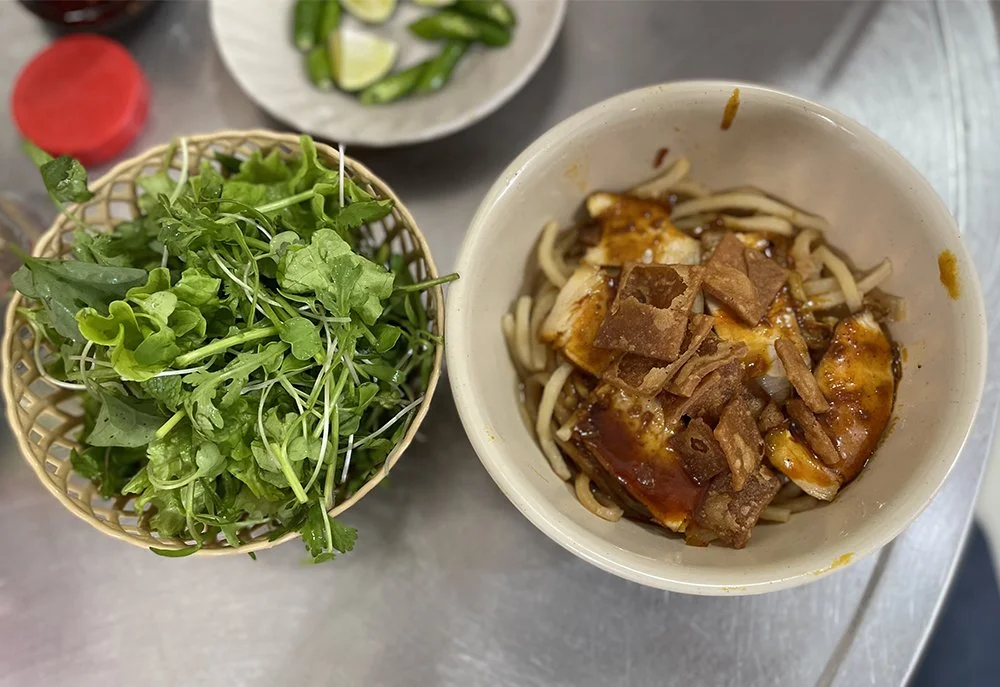
Cao Lau and Herbs

What is Bánh Căn?
Bánh Căn is a unique dish not to be confused with the noodle dish, Bánh Cănh (see the ‘h’ at the end of the ‘can’ makes all the difference).
Bánh Căn is a unique dish not to be confused with the noodle dish, Bánh Cănh (see the ‘h’ at the end of the ‘can’ makes all the difference). To be honest, I had never seen this dish before despite travelling to Vietnam in 2012 and 2018. It is a wonderfully theatrical dish that is expertly made with precision, skill and speed. Bánh Căn is originally of the Cham minority people in the Ninh Thuan Province.
Nha Trang, Dalat and Phan Rang have their own versions of this dish, however the foundation of it is made out of cooked rice that is blended and sun-dried rice flour is added to create a crispy, yet fluffy omelette-type cake. There are a few cities that make Bánh Căn, differing in size, cooking technique, ingredients used, and each vendor will put their own signature spin on it.
In Saigon, you will find a similar dish known as Bánh khọt, this version is eaten with different sauces, ingredients and the base is made with fried rice flour, turmeric and coconut. Bánh khọt is either cooked in a cast iron dish and not necessarily over charcoal or fried.
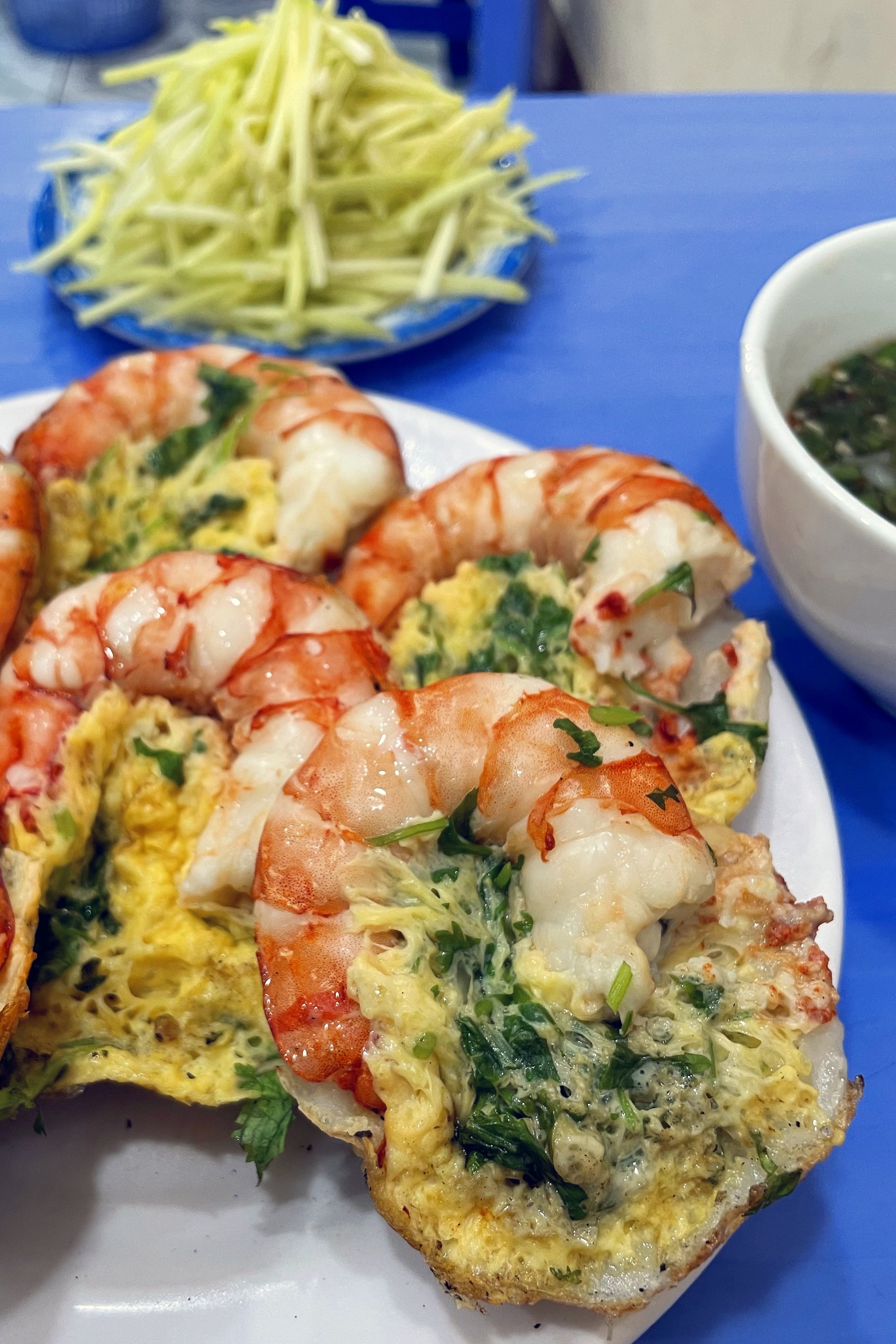
How is Bánh Căn made?
Bánh căn is a unique dish that requires a very specific cooking mold and these vary in size. It is essentially a large terracotta plate made by Cham potters with several circles cut out of the inside. These holes are filled with small terracotta dishes that all have little hat type lids with handles that fit on top. The entire plate sits above red-hot burning coals to impart the perfect charcoal flavour.
The rice flour batter is poured into each mold until it curls up around the sides and starts to bubble, the toppings are then added whether it be a simple quail egg, minced meat or seafood. The lids are placed on top of the the inserts until the batter and toppings are cooked through.
Dalat Bánh Căn
Dalat city sits 1500 metres above sea level within the Southern Central highlands. A city of contrasting architecture, beautiful landscape, it is home to the most beautiful produce in Vietnam that grows all year round. The weather is much cooler in Dalat, and this is a reflection of the dishes that are found in and around the city, and Dalat Bánh căn is no exception. The steaming hot rice cakes are piled on top of each other and look like a mini burger. The simpler versions of Dalat Bánh Căn contain a quail egg and served with a dipping sauce that could easily be mistaken as a soup. The dipping sauce is made with fish sauce or fermented shrimp paste, green onions, and can sometimes contain pork meatballs within or on the side. Some places in Dalat serve Bánh Căn with ham and a glass of fresh soy milk to go with it.
Nha Trang Bánh Căn
The Banh Can here is iconic. Following the rice flour base, the toppings are loaded with huge prawns, minced meat, eggs, squid or octopus. The dipping sauce is sweet and savoury with fish sauce, green onions, sugar and is perfect with just a little bit of chilli. The pork meatballs in the dipping sauce are sometimes cooked over charcoal imparting a delightful smoky flavour. Alongside the dipping sauce, shredded green mango is served which you can either throw in your dipping sauce or use to cleanse your palate – anything goes!
Phan Rang Bánh Căn
Pahn Rang is quite close to Nha Trang so there are a lot of similarities between how these two towns serve the dish. Here, the rice – omelette cake things can be served with a variety of fish sauce based dipping sauces that can be sweet, sour or even have peanuts added to them. Green mango is also served with the Phan Rang Banh Can, and sometimes some greens which you can wrap them in.
Bánh Căn is also found in major cities from Danang all the way to Saigon, I would have to say my favourite place to eat them was in Nha Trang, yet every vendor has their own spin on this wonderfully unique Central Vietnam dish. You must try it when you are here – and tell me what you think!!!
