
explore the world through the universal language of food
Ramen.... a brief history
Throughout Asia, noodle dishes are one of the most popular to eat and come in varying types of textures, ingredients used, serving, and cooking methods. While each country prides itself on a significant noodle dish, one of the most recognised types of noodles within both the region and Internationally is ramen. Ramen is a humble dish of wheat noodles, broth, toppings and is synonymous with Japanese food and culture, developing over the years with the evolution of Japan.
Throughout Asia, noodle dishes are one of the most popular to eat and come in varying types of textures, ingredients used, serving, and cooking methods. While each country prides itself on a significant noodle dish, one of the most recognised types of noodles within both the region and Internationally is ramen. Ramen is a humble dish of wheat noodles, broth, toppings and is synonymous with Japanese food and culture, developing over the years with the evolution of Japan.
Japan’s surrounding countries have strongly influenced its food culture starting from as early as 300BC. The Chinese have influenced a diet of rice and noodles within the Japanese culture and the introduction of Buddhism from Korea eventuated into a 1200 year ban on beef products, equipping the country to master the art of sushi and be world-renowned for its high-quality seafood.
The treaty of peace and amity in 1854 forced Japan to open its ports to American trade, ushering in a plethora of immigrants and foreign workers into the country. Yokohama, once a tiny fishing village, boomed because of the treaty and grew immensely with the rise of Industrialisation in 1868.
The first Chinese restaurant opened in Yokohama in 1870 and as Japan’s economy grew, many more Chinese students and workers migrated and spread around the country. Rairaiken , a restaurant in the Asakusa district of Tokyo, opened in 1910
In the Asakusa district of Tokyo, a restaurant run by Chinese workers opened in 1910 and served a dish called Shina Soba (Chinese Soba). This dish consisted of broth, noodles, pork, fishcake and nori, closely resembling ramen of what we know of today.
The word ramen relates to the actual noodles, transcribed into Japanese from the Chinese word ‘la mian’, meaning pulled noodle. Lamian noodles are from Lanzhou, made from wheat flour that is pulled, folded and stretched until the correct thickness is achieved.

Shina Soba
Credit: fukuokanow.com
Despite hiding behind a façade of a humble bowl of soupy noodles, the elements of ramen are complex, time-consuming and require extreme perfection to achieve a delicious, balanced dish. Those elements comprise broth, tare, noodles and toppings.
Broth
Traditionally ramen is made with a pork broth which requires many hours of simmering pork bones to extract collagen, fat and flavour. The combination of both pork and chicken broth is also popular and in modern style ramens, crab, prawn and lobster stock is also used.
Tare
The flavour of ramen can be credited to tare, the seasoning element of the broth containing glutamate through umami rich foods or the addition of monosodium glutamate. Dashi, made with kombu (kelp), katsuboshi (smoked and dried bonito flakes) OR niboshi (anchovy), is also used in the tare to add a full flavoured layer of umami.
Shio (salt), Shoyu (soy sauce) and Miso (fermented bean paste) are the building blocks on which the three types of tare is built. Other ingredients can be simmered with these base flavours such as sake, ginger, mirin, vinegar, garlic or green onions. Shio tare results in a clean and pure taste, Shoyu adds sweetness and colour while miso provides an earthy taste with an opaque appearance.

Credit @Julianamalta
Noodles
Ramen noodles come in a variety of textures and shapes and are made simply from wheat flour, salt, water and alkalized mineral water also known as kansui. Kansui is the essential ingredient in the noodle allowing them to have a bouncy texture and egg-like flavour. The colour and texture depends on how much kansui has been added to the dough and the noodles can be flat, wavy, curly, thick or thin.
Toppings
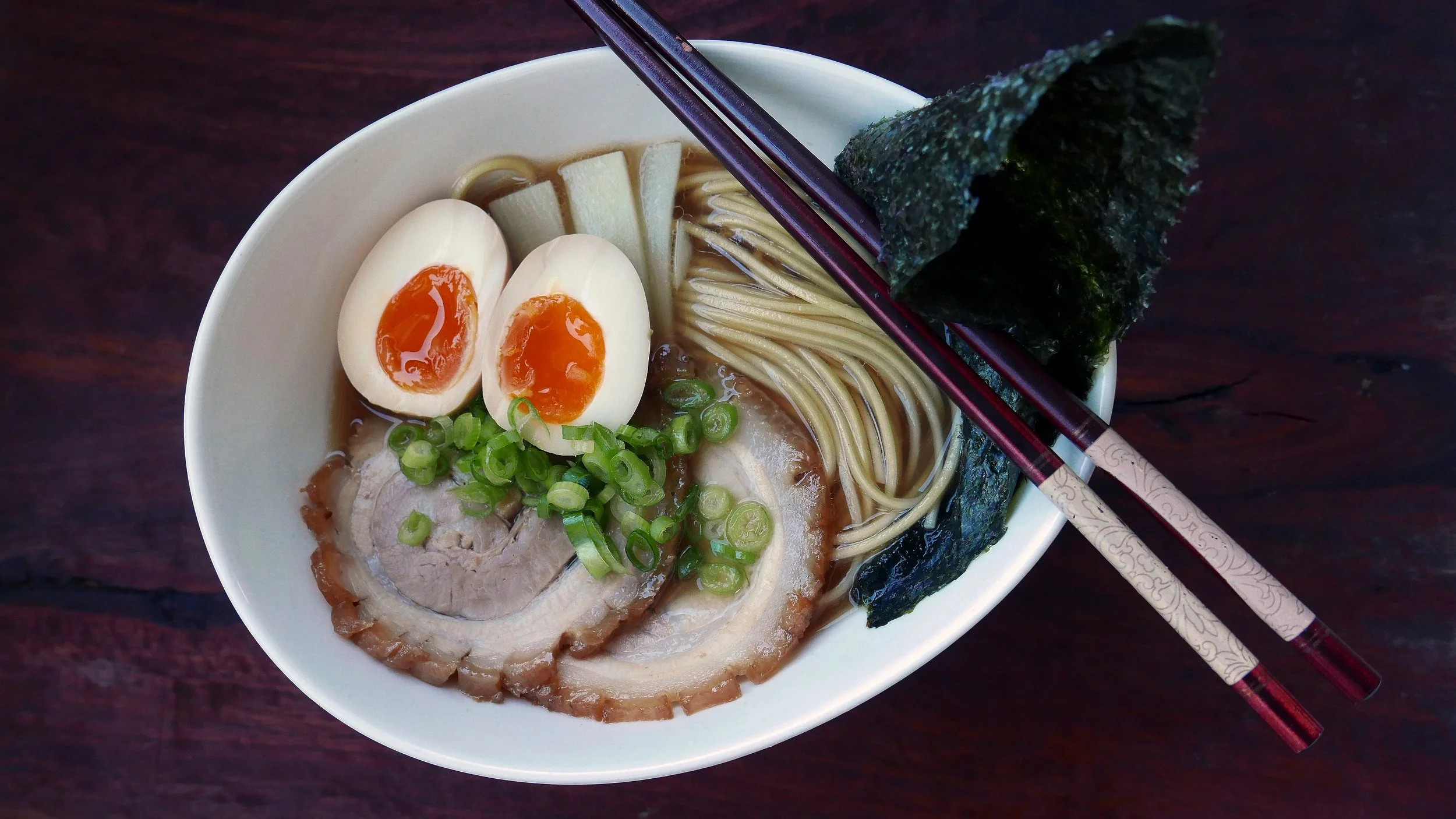
Toppings of ramen vary and can include chashu (grilled braised pork belly), ajitsuke tamago (marinated egg), Naruto (fish cakes), Nori (seaweed paper), bean sprouts, corn, menma (fermented bamboo shoots), black fungus, corn, spicy miso and many more.
I made a ramen stock with a kilo of pigs trotters, tare and dashi from scratch to learn the entire process, but I wouldn’t put you through that!!!
Here’s a quick ramen you can do with either roasted chicken or roasted pork.
The essential part of ramen.
THE RECIPE
Serves 4
Preparation Time: 20 minutes + 2days marinating (eggs)
Cooking Time: 25 minutes
Ajitsuke Tamago
4 medium eggs
60mls soy sauce
60mls mirin
100-120 mls water
Method
Bring water to a rolling boil
Drop in eggs and reduce the water to a simmer for about 7 mins, move the eggs around the saucepan
When the timer is done, place the eggs into an ice bath to stop the cooking process immediately.
Peel the eggs and place them in a sealed bag with the liquid. Allow to marinate for a minimum 2 days
Ramen Stock
1.5L chicken stock or pork stock (low or no salt)
30mls mirin
30mls sake
60mls soy sauce
60 mls dashi stock*
½ tsp rice wine vinegar
½ tsp brown sugar
1 clove garlic, peeled
thumb size piece of ginger, peeled
10g spring onion, roughly chopped
*if you cannot get your hands on kombu or dashi, try 30g of dried shiitake mushrooms
400g ramen noodles (if you can find the alkalized noodles and not the instant ones!)
Method – stock & noodles
Add all the ingredients into a large pot, bring to a light boil then reduce to a simmer. Allow to simmer for 20-30 minutes, fine strain twice before serving. Taste and season accordingly.
Bring a medium sized pot of water to the boil, add in ramen.
Cook until al dente and strain out the strain out the noodles
To Serve
In large warmed bowls, ladle in the ramen stock and the cooked noodles
Top with roasted meat, ajitsuke tamago, bamboo, spring onions and a sheet of nori


Banana and Oat Crumble Muffins
Being back in Australia, I am overwhelmed by the giant food portions here but I am extremely happy to find a good muffin with a solid top quite frequently. I’m not really sure why there aren’t many good muffin choices to be found in Singapore - I mean, cake for breakfast, who wouldn’t want that?
It’s really quite easy to bake a good muffin and just as easy to bake a bad muffin that is too dry, not full of enough ingredients and the worst - doesn’t have a muffin top.
So here is a simple recipe for a banana and oat muffin with a crispy muffin top. Let me know what you think and if you have any other flavour combinations you would like me to make!
It’s a short and sweet kind of day. Less talk, more baking.
Enjoy your weekend xx
Cake for breakfast? Blasphemy. Muffins for breakfast - ok sure!
How muffins are acceptable for breakfast and cake is not, is still a mystery to me but I will eat either at any time of the day. The essence of a good muffin is the muffin top, without it, we can just call it a naked cupcake.
Muffins are a ‘quick bread’ that is a result of the inclusion of pearlash into baked goods. Pearlash (potassium carbonate), the world’s first chemical leavener, was introduced into American households in the 18th Century. Before this, ‘cakes’ and bread used yeast as a raising agent (read more about yeast and bread history). Today in baking we use baking soda/bicarbonate soda which is a white crystalline powder that is alkaline. When it comes into contact with an acidic product (yoghurt, buttermilk etc) or liquid, it creates carbon dioxide, air bubbles are created and your bake. goods rise.
Whether muffins are good for you or not, if you eat them for breakfast or any time of the day, you deserve a little treat now and then. If you are baking for a smaller crowd, this recipe can also be halved. Happy baking, enjoy and let me know how those muffins turn out!

THE INGREDIENTS
Muffin Batter180g wholemeal flour
100g unbleached white flour
100g brown sugar
100g white sugar
2 tsp baking powder
2 tsp cinnamon powder
1 tsp ginger powder
100g toasted oats
pinch of fine sea salt
350g really ripe bananas (3-4)
120g unsalted butter, melted
100g natural yoghurt
2 medium eggs
1/2 tsp vanilla extract
Oat Crumble
80g oats
50g plain unbleached flour
60g brown sugar
60g unsalted butter, cold and cubed
pinch of fine sea salt salt
1 extra banana for garnish
METHOD
Preheat the oven to 180’C
Grease a 12 whole muffin tin with butter or oil. Sprinkle a small amount of flour of it and tip out the excess
In a medium bowl, whisk the flours, sugar, spices and baking powder.
In a separate bowl, mash up the bananas with a fork really well. Then add eggs, vanilla and melted butter and mix until smooth
Mix the wet ingredients into the dry until combined. Make sure you do not over mix as this will work the gluten in the flour and make the muffins dry and tough.
For the oat crumble, Add flour, salt, sugar and oats into a small bowl. Rub in butter until the mixture comes together in clumps. Set aside
Fill up the muffin tins with the batter, leaving about 1cm space from the top (this will ensure a good muffin top)
Sprinkle the muffin batter with the oat crumble mixture evenly
Slice the banana (if using), diagonally and place into the centre of each muffin.
Bake in the oven for 20-25 minutes or until the muffins are brown and cooked through (check with a sharp knife or cake tester inserted in the middle, it should come out clean)
Allow muffins to cool in the tin before turning out onto a cooling rack
Enjoy for breakfast, lunch or dinner :)


